
As the water trickled over the rocks and my kids explored the bush, their laughter mingling with birdsong, I sat quietly on the wooden seat, taking it all in.
The peace, the joy - but also something else.
My eyes welled up just as my independent support worker glanced at me. She slipped an arm around me and gave a gentle squeeze.
I didn't need to explain what I was feeling but she already knew. That feeling is something that I think every parent living with a disability needs to hear and embrace.
A different kind of angst
Mum - and dad - guilt is almost synonymous with parenting these days.
We worry we're not doing enough, not being enough; that there's never enough time, money, or energy.
But when you're parenting with disability, that feeling cuts deeper.
It's the sting when you can't do something for, or with, your kids. Like driving them to a birthday party, kicking a soccer ball in the backyard.
It's crying quietly in the kitchen when disability and parenthood all feels too much.
It's the pang of worry about the future, wondering if one day my children will need to care for me, and what that will mean for them.
And all of this sits on top of everything every other parent carries. As a mum, I know it intimately.
Olympic-level jugglers
If juggling was an Olympic sport, mums would be the elite athlete competitors.
The balls are constant - lunchboxes packed, forms signed, dates held in our heads and phones, socks paired (or not), work done, dinner cooked. And then the invisible ones. Noticing a mood shift before it spirals, remembering who's struggling with which subject or friendship, winding everyone down for bedtime, untangling worries before sleep.
The mental load hums as constant as the washing machine that never quite clicks off.
And then there's me.
Legally blind, severely hearing impaired, unsteady on my feet, while managing a chronic medical condition that depletes me of energy.
I can't drive. I can't safely cross a road alone or sit through a parent information night. I work part-time and have two school-aged kids.
And yet in some ways, it feels more manageable than it should.
Not doing it alone
The difference is, I'm supported. I wasn't always, but as my disabilities have worsened over the years, I now have both informal and formal support in place.
And it's been a game-changer.
For example, recently my mum drove my dog and me to the vet, one arm linked through mine, the other holding his lead. She stayed while the vet spoke, catching what I might have missed and repeating it later.
My husband worked all week, and when he wasn't, he was the family taxi driver taking our kids to soccer training, art class, and tutoring. Kids in and out of the car, milk and bread tucked under his arm as he came back through the door.
A fortnightly house cleaner took care of the bathroom, kitchen, and floors, leaving me with the lighter, daily jobs I can manage.
And my incredible independent support worker, Belinda - who I found on Mable - spent ten hours alongside me.
She grocery shopped, prepped meals for low-energy nights, and drove me to my oncologist so I could access the medication that keeps my condition at bay. We sorted my kids' wardrobes,- and when she left, she took a bag of donations to the charity bin on the way home.
In between, I worked. I folded the laundry. I reminded my kids, again, to do their homework, their chores, to brush their teeth. And I kissed them goodnight.
Just like every other parent.
It was a normal week. But I was held up. The balls kept moving.
Support, for me, isn't extra. It's structure - the scaffolding that holds my day and life together.
But it's something more than that, too.
It's meaningful
When I told Belinda I wanted to take my kids on a nature adventure, the old 'less than' thought crept in.
I can't do that… or maybe I can?
She suggested a short, manageable walk. There were some stairs, exposed roots, low-hanging vines to dodge. But with big and little hands guiding me and keeping me from falling, along with a steady chorus of 'You're good, Mum - we've got you,' I made it to the waterfall.
And that's when the most beautiful realisation dawned on me.
Support doesn't just make my life more manageable - it makes it more meaningful.
Walking through the bush. Finding the waterfall. Sharing that moment with my kids was special and a treasured memory. I wasn't on the sidelines. I was in it.
Parenting with a disability isn't easy. It's hard in ways only those living it truly understand.
My world is still distorted, confusing, exhausting, but the way I move through it has changed. With support, I am stronger. I am happier. I feel I can be more, not less. I know I have to lean into support. Ask for it. Accept it. Embrace it.
Because mums with disabilities are the quiet supermums.
But support? Support is our cape.
About the author
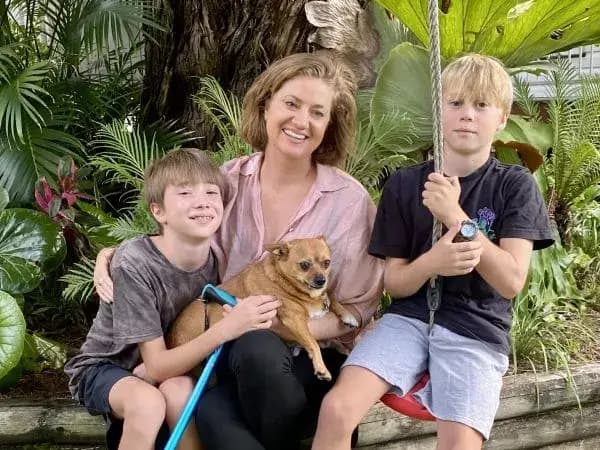
Lana Hallowes is a freelance journalist and mum of two boys. She is a disability and inclusion advocate, being legally blind, hearing and balance impaired. Her blue walking stick is her favourite accessory.


